Welcome to DU!
The truly grassroots left-of-center political community where regular people, not algorithms, drive the discussions and set the standards.
Join the community:
Create a free account
Support DU (and get rid of ads!):
Become a Star Member
Latest Breaking News
Editorials & Other Articles
General Discussion
The DU Lounge
All Forums
Issue Forums
Culture Forums
Alliance Forums
Region Forums
Support Forums
Help & Search
Canada
Related: About this forumOn the evening of December 6, 1989, the Ecole Polytechnique massacre occurred in Montreal.
École Polytechnique massacre
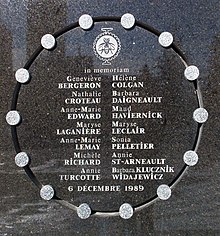
Plaque at École Polytechnique
commemorating victims of the massacre
Location: Montreal, Quebec, Canada
Date: December 6, 1989; 36 years ago
Target: Women at École Polytechnique de Montréal
Attack type: Mass shooting, mass murder, school shooting, femicide, murder-suicide
Weapons: Ruger Mini-14 semi-automatic rifle, Hunting knife
Deaths; 15 (including the perpetrator)
Injured; 14 (including Nathalie Provost)
Perpetrator; Marc Lépine
Motive; Antifeminism, misogyny
The École Polytechnique massacre (French: tuerie de l'École polytechnique), also known as the Montreal massacre, was an antifeminist mass shooting that occurred on December 6, 1989 at the École Polytechnique de Montréal in Montreal, Quebec. Fourteen women were murdered; another ten women and four men were injured.
Perpetrator Marc Lépine, armed with a legally obtained Ruger Mini-14 semi-automatic rifle and hunting knife, entered a mechanical engineering class at the École Polytechnique. He ordered the women to one side of the classroom, and instructed the men to leave. After claiming that he was "fighting feminism", he shot all nine women in the room, killing six. The shooter then moved through corridors, the cafeteria, and another classroom, specifically targeting women, for just under 20 minutes. He killed eight more women before ending his own life. In total, 14 women were killed, and 14 others were injured.
The massacre is now widely regarded as an anti-feminist attack and representative of wider societal violence against women; the anniversary of the massacre is commemorated as the National Day of Remembrance and Action on Violence Against Women. After the attack, Canadians debated various interpretations of the events, their significance, and the shooter's motives. Other interpretations emphasized the shooter's abuse as a child or suggested that the massacre was the isolated act of a madman, unrelated to larger social issues.
The incident led to more stringent gun control laws in Canada, and increased action to end violence against women. It also resulted in changes in emergency services protocols to shootings, including immediate, active intervention by police. These changes were later credited with minimizing casualties during incidents in Montreal and elsewhere. The massacre remained the deadliest mass shooting in Canada until the 2020 Nova Scotia attacks over 30 years later.
{snip}
Plaque at École Polytechnique
commemorating victims of the massacre
Location: Montreal, Quebec, Canada
Date: December 6, 1989; 36 years ago
Target: Women at École Polytechnique de Montréal
Attack type: Mass shooting, mass murder, school shooting, femicide, murder-suicide
Weapons: Ruger Mini-14 semi-automatic rifle, Hunting knife
Deaths; 15 (including the perpetrator)
Injured; 14 (including Nathalie Provost)
Perpetrator; Marc Lépine
Motive; Antifeminism, misogyny
The École Polytechnique massacre (French: tuerie de l'École polytechnique), also known as the Montreal massacre, was an antifeminist mass shooting that occurred on December 6, 1989 at the École Polytechnique de Montréal in Montreal, Quebec. Fourteen women were murdered; another ten women and four men were injured.
Perpetrator Marc Lépine, armed with a legally obtained Ruger Mini-14 semi-automatic rifle and hunting knife, entered a mechanical engineering class at the École Polytechnique. He ordered the women to one side of the classroom, and instructed the men to leave. After claiming that he was "fighting feminism", he shot all nine women in the room, killing six. The shooter then moved through corridors, the cafeteria, and another classroom, specifically targeting women, for just under 20 minutes. He killed eight more women before ending his own life. In total, 14 women were killed, and 14 others were injured.
The massacre is now widely regarded as an anti-feminist attack and representative of wider societal violence against women; the anniversary of the massacre is commemorated as the National Day of Remembrance and Action on Violence Against Women. After the attack, Canadians debated various interpretations of the events, their significance, and the shooter's motives. Other interpretations emphasized the shooter's abuse as a child or suggested that the massacre was the isolated act of a madman, unrelated to larger social issues.
The incident led to more stringent gun control laws in Canada, and increased action to end violence against women. It also resulted in changes in emergency services protocols to shootings, including immediate, active intervention by police. These changes were later credited with minimizing casualties during incidents in Montreal and elsewhere. The massacre remained the deadliest mass shooting in Canada until the 2020 Nova Scotia attacks over 30 years later.
{snip}
Dec 2024: On the evening of December 6, 1989, the Ecole Polytechnique massacre occurred in Montreal.
Wed Dec 6, 2023: On the evening of December 6, 1989, the Ecole Polytechnique massacre occurred in Montreal.
Thu Dec 8, 2022: On December 6, 1989, the Ecole Polytechnique massacre occurred in Montreal.
Hat tip, niyad
Fri Dec 7, 2018: Ecole Polytechnique (Montreal) massacre 6 December 1989

1 replies
 = new reply since forum marked as read
Highlight:
NoneDon't highlight anything
5 newestHighlight 5 most recent replies
= new reply since forum marked as read
Highlight:
NoneDon't highlight anything
5 newestHighlight 5 most recent replies
= new reply since forum marked as read
Highlight:
NoneDon't highlight anything
5 newestHighlight 5 most recent replies
On the evening of December 6, 1989, the Ecole Polytechnique massacre occurred in Montreal. (Original Post)
mahatmakanejeeves
Dec 7
OP

cbabe
(6,420 posts)1. How a Montreal Massacre survivor became a character in a Louise Penny detective novel
https://www.cbc.ca/radio/asithappens/nathalie-provost-louise-penny-1.6674734
How a Montreal Massacre survivor became a character in a Louise Penny detective novel
Nathalie Provost says she was thrilled to become a part of Louise Penny’s bestselling series
Sheena Goodyear · CBC Radio · Posted: Dec 05, 2022 2:33 PM PST | Last Updated: December 6, 2022
Louise Penny says she was "very nervous" when she called École Polytechnique shooting survivor Nathalie Provost to ask whether she could write her into her new novel.
It turns out Penny had nothing to worry about: Provost was already a huge fan.
"I was really excited and amazed for this extraordinary proposition. And for me, it was clearly a yes," Provost said. "When somebody calls me to talk about Polytechnique, I say yes. We have to keep the memory alive."
Penny, a CBC reporter-turned-bestselling author, and Provost, an engineer and gun control advocate, both joined As It Happens host Nil Köksal to talk about Penny's latest novel, A World of Curiosities. The book includes a fictionalized account of the Dec. 6, 1989, École Polytechnique shooting.
Tuesday marks 33 years since shooter Marc Lépine walked into a classroom full of students at the Montreal post-secondary school, ordered the men to leave, proclaimed his hatred for feminism, then opened fire, killing 14 women and injuring 14 others.
The shooting has left an indelible mark on Quebec, and served as a Canada-wide wake-up call about the dangers of violent misogyny.
… more …
How a Montreal Massacre survivor became a character in a Louise Penny detective novel
Nathalie Provost says she was thrilled to become a part of Louise Penny’s bestselling series
Sheena Goodyear · CBC Radio · Posted: Dec 05, 2022 2:33 PM PST | Last Updated: December 6, 2022
Louise Penny says she was "very nervous" when she called École Polytechnique shooting survivor Nathalie Provost to ask whether she could write her into her new novel.
It turns out Penny had nothing to worry about: Provost was already a huge fan.
"I was really excited and amazed for this extraordinary proposition. And for me, it was clearly a yes," Provost said. "When somebody calls me to talk about Polytechnique, I say yes. We have to keep the memory alive."
Penny, a CBC reporter-turned-bestselling author, and Provost, an engineer and gun control advocate, both joined As It Happens host Nil Köksal to talk about Penny's latest novel, A World of Curiosities. The book includes a fictionalized account of the Dec. 6, 1989, École Polytechnique shooting.
Tuesday marks 33 years since shooter Marc Lépine walked into a classroom full of students at the Montreal post-secondary school, ordered the men to leave, proclaimed his hatred for feminism, then opened fire, killing 14 women and injuring 14 others.
The shooting has left an indelible mark on Quebec, and served as a Canada-wide wake-up call about the dangers of violent misogyny.
… more …