A 5,300-year-old 'bow drill' rewrites the story of ancient Egyptian tools
By:
Mark Milligan
Date:
February 11, 2026
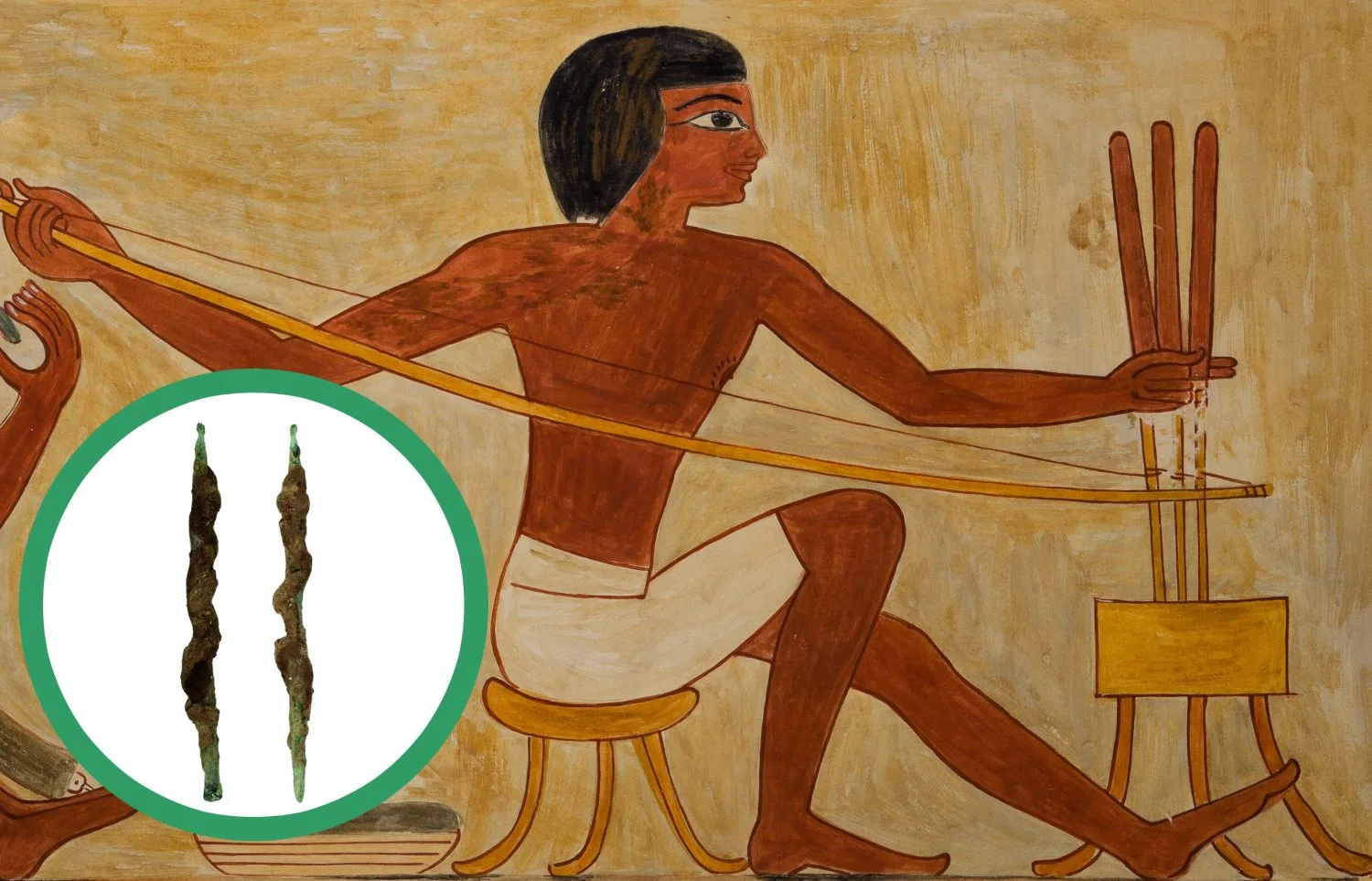
A recent study has recontextualised a small copper-alloy artefact from Predynastic Egypt, identifying it as the earliest securely attested rotary metal drill in the Nile Valley.
The object, dated to the late fourth millennium BC (ca. 3300–3000 BC), predates the political unification of Egypt and the emergence of the pharaonic state.
HOMEPAST SCIENCESGEOSCIENCESGENERAL SCIENCESTRAVELSHOP
Image Credit : Newcastle University
By:
Mark Milligan
Date:
February 11, 2026
Archaeology
A 5,300-year-old ‘bow drill’ rewrites the story of ancient Egyptian tools
A recent study has recontextualised a small copper-alloy artefact from Predynastic Egypt, identifying it as the earliest securely attested rotary metal drill in the Nile Valley.
x
Pause
Unmute
Fullscreen
Now Playing
x
video of: Unveiling the Secrets of Egypt's PyramidsPlay Video
Unveiling the Secrets of Egypt's Pyramids
Watch on
Video channel logo
Unveiling the Secrets of Egypt's Pyramids
The object, dated to the late fourth millennium BC (ca. 3300–3000 BC), predates the political unification of Egypt and the emergence of the pharaonic state.
- Advertisement -
The artefact was originally excavated in the early twentieth century from Grave 3932 at the Badari cemetery in Upper Egypt. Now housed in the Museum of Archaeology and Anthropology (catalogue no. 1924.948 A), it measures 63 mm in length and weighs approximately 1.5 g. When first published in the 1920s, it was briefly described as “a little awl of copper, with some leather thong wound round it,” a characterisation that led to decades of relative scholarly neglect.
A new interdisciplinary reassessment by researchers at Newcastle University and the Academy of Fine Arts Vienna challenges that interpretation. Microscopic analysis revealed diagnostic use-wear patterns—fine circumferential striations, edge rounding, and slight distal curvature—consistent with sustained rotary motion rather than simple puncturing. These features strongly indicate that it was used as a drill bit rather than an awl.
The study, published in Egypt and the Levant, also reexamined six tightly wound coils of extremely fragile leather thong preserved around the shaft. The authors argue that these are the remains of a bowstring, providing rare organic evidence for the use of a bow drill. In such systems, a cord is wrapped around a vertical shaft and driven by a reciprocating bow, generating rapid rotational motion and significantly improving efficiency and control compared with hand-twisting methods.
More:
https://www.heritagedaily.com/2026/02/a-5300-year-old-bow-drill-rewrites-the-story-of-ancient-egyptian-tools/156988
