Anthropology
Related: About this forum
Hunter-gatherers took refuge in European 'water world' for millennia
11 February 2026
Ancient inhabitants of the Rhine–Meuse river delta resisted population shifts that transformed most of Europe — until they helped to catalyse the expansion of ‘Bell Beaker’ culture.
By Ewen Callaway
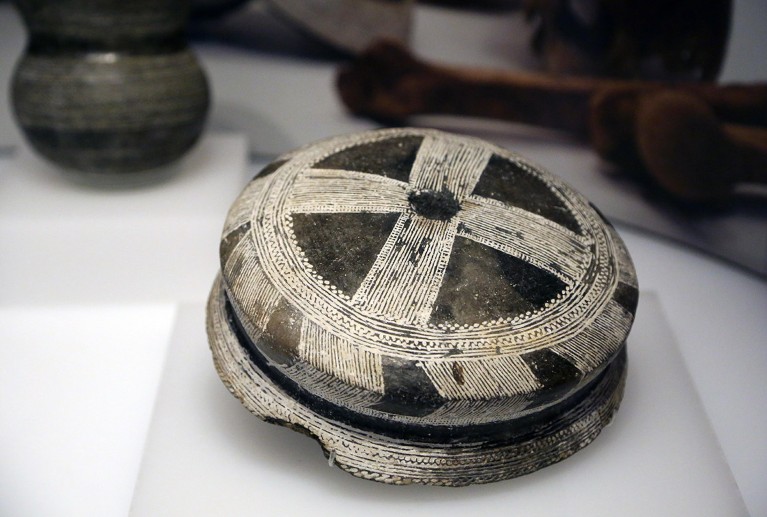
The Bell Beaker culture, named after a type of ceramic vessel, arose in Europe from around 2800 BC.Credit: Lanmas/Alamy
A western European ‘water world’ was a holdout for hunter-gatherers for thousands of years.
Ancient inhabitants of the Rhine–Meuse river delta — wetland, riverine and coastal areas of modern-day Netherlands, Belgium and western Germany — maintained high levels of hunter-gatherer genetic ancestry. This genetic signature persisted long after most of Europe was transformed into farming and animal-herding-based communities by successive migrations from the east, starting around 9,000 years ago. The findings come from a study published in Nature on 11 February1.
“It’s really an island of persistence and resistance to the incorporation of external ancestry,” says David Reich, a population geneticist at Harvard Medical School in Boston, Massachusetts, who co-led the study.
Cultural integration
For two decades, ancient-genomics laboratories, including Reich’s, have painted Europe’s population history over the past 10,000 years in broad brushstrokes. This work showed that resident hunter-gatherers were, to varying degrees, replaced by Middle Eastern farmers, who were themselves usurped by pastoralists whose ancestry traced back to the central Eurasian steppe (see 'Hunter-gatherers holdouts').
More:
https://www.nature.com/articles/d41586-026-00440-z
 = new reply since forum marked as read
Highlight:
NoneDon't highlight anything
5 newestHighlight 5 most recent replies
= new reply since forum marked as read
Highlight:
NoneDon't highlight anything
5 newestHighlight 5 most recent replies

erronis
(25,239 posts)"DNA Reveals the People Who Replaced Stonehenge's Builders Along With 90% of Britain's Population Came from a Dutch Swamp"
Thanks for your wonderful, enlightening articles, Judi.
